(It’s best to read this in the context of Two perspectives on the world—and little overlap or Feudalism, Power, and Violence, because those works contain the relevant perspectives.)
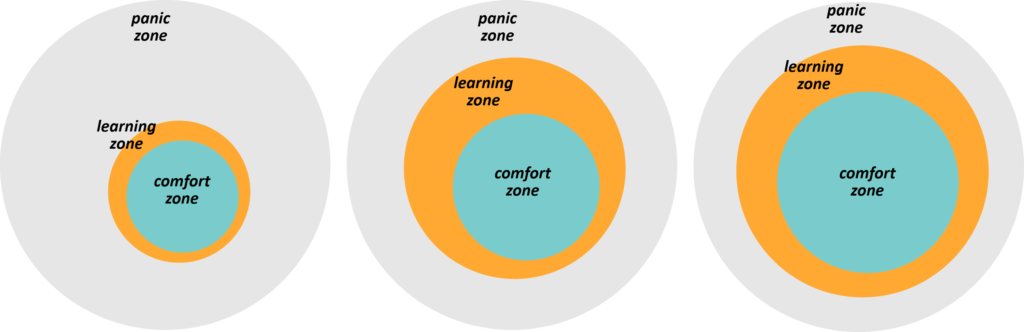
Even though the scientific basis is limited, most of us can relate to the comfort zone model. There are various versions circulating online and in the literature; here, I’ll use the version that includes the comfort zone, the learning zone, and the panic zone that follows.
Comfort Zone Model 1.0
The idea behind this is simple and aligns quite well with Carol Dweck with her “Fixed vs. Growth Mindset”. If I stay only within my comfort zone, it shrinks. If I try to carefully expand my comfort zone, I repeatedly enter the learning zone (while avoiding the panic zone), and then both the comfort zone and the learning zone continue to grow.
This makes perfect neurological sense, because anything unfamiliar scares us (i.e., the gecko or panic zone). The more familiar it becomes, the more relaxed we are.
If we even learn how to learn, then learning itself (the change, or in this case, the expansion of the zones) becomes familiar, and we remain relaxed even as we explore.
Sounds cool, right?
And so incredibly simple. But why does it work for some things and not at all for others? Could it be that there’s another perspective—or another dimension—missing?
The Blind Spot: Limbi
If we look only at the neocortex—that is, if we view ourselves as intelligent machines—then this fits perfectly. But if we use a very simple model of the brain, one that already breaks it down into different functions, then the picture looks quite different.
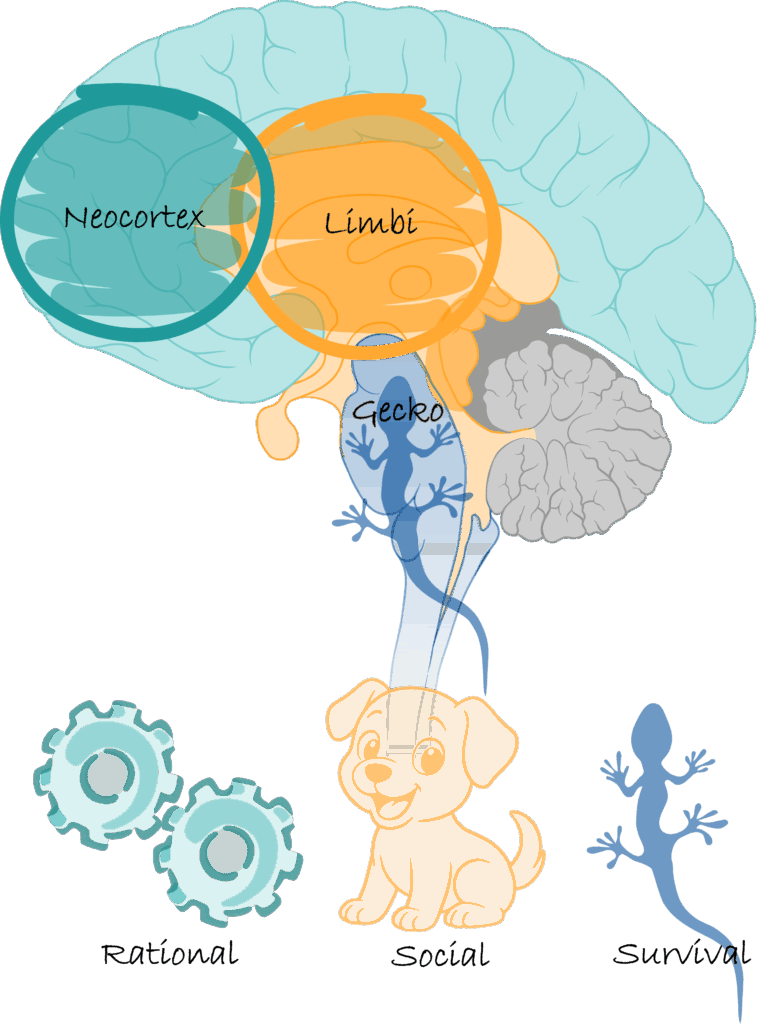
This model is a bit outdated, but it’s perfectly adequate here and easier to understand than current neural network prediction models.
The basic idea is that the neocortex is responsible for rational thought—that is, all conscious thinking and decision-making. That’s great, and it’s the part that’s emphasized in education and training. The civilized view of humans is: Everything should be neocortex, and the rest should ideally be suppressed.
The second part—our Limbi or limbic system—is our emotional or social intelligence. This part of the brain is excellent for everything related to relationships or cohesion within a group. It’s about fulfilling basic emotional or psychological needs. Not just mine, but everyone’s in the group—in the system—because the fulfillment of basic needs can only succeed in a social context. Never alone, on one’s own.
In the civilized world, however, we want to suppress this because that part cannot be controlled or directed. It simply does its own thing. Just being social, which is directly opposing feudalism thoughts.
That is why, for many centuries in the civilized world, the greatest virtue has been to shut that part down. Traditionally, this has been even more so for men than for women. And even more so for the nobility than for the common people.
The problem: When Limbi is suppressed, he (or she) goes into resistance. Limbi keeps the reins in hand (because Limbi largely decides what information even reaches the neocortex), but he tends to work against our conscious decisions. We are torn.
And if our limbic system is rejected, then we don’t feel safe inside. We feel somehow wrong. So we live in fear. Our Gecko is also active all the time. We feel threatened everywhere, especially where we should actually be safe.
Model Update: Version 2.0
So when we factor in this worldview, we end up with a new model. Let’s break it down into three stages.
The first stage is “the world is hostile.” Danger lurks everywhere. Our lizard brain, the Gecko, is constantly on the move—always and everywhere. We’re in survival mode. The comfort zone isn’t safe; it’s just a familiar danger.
The basic assumption in this worldview is: If things are already this bad in my comfort zone, then they’re much worse everywhere else. And the outer edge is “coping.” So how can I numb or block out danger and everything unknown?
Missed the Worldview Update?
This state of mind—in its various forms and degrees—is very widespread. We can assume that approximately 80% of people hold this worldview.
The reason is that they never had a chance to update their worldview. Our initial worldview is formed during childhood, particularly between the ages between 7 and 12. Once we’ve survived that, our brain says, “Okay, now we know what works to stay alive.” It’s less about what feels good and more about what works. After that, the rule is: “What’s familiar is good. Let’s keep doing that.”
Since we spend this time with our birth family, there is still a second chance afterward. Between the ages of 12 and 16, we have the opportunity for an update. At that age, we are “adults” and should leave our family of origin. This gives us the chance, over several years, to gain a second opinion, a different perspective on life. We can question everything we’ve learned up to that point. What stands up to this update can stay; everything else gets updated.
After that (until around age 25), all unused areas will be dismantled.
Many of us are familiar with this kind of questioning from our teenage years. The underlying mechanism is still there and still works. Unfortunately, however, there’s no change in context. We’re stuck in the same family of origin, in the same schools, and even in the same cliques and peer groups. Some generations try to rebel, but most of the time, only the right questions remain—the new answers are missing. So we miss out on the update and get stuck in a worldview that’s too narrow.
The brain’s plasticity remains. So we can update our worldview at any time, but it’s much more difficult. It takes a lot more energy. It would be wiser to work with biology rather than constantly fighting against it, and to make use of the energy and opportunities it offers.
The second stage is based on a simple assumption: What if I was just unlucky (“the world is unfair”) and there was a disproportionate amount of danger in my “comfort zone”? I grew up in a place where there was danger, but there may be parts of the world that are much safer. This gives me the motivation to expand my comfort zone. I want to grow anyway, which is why the next zone is my growth zone.
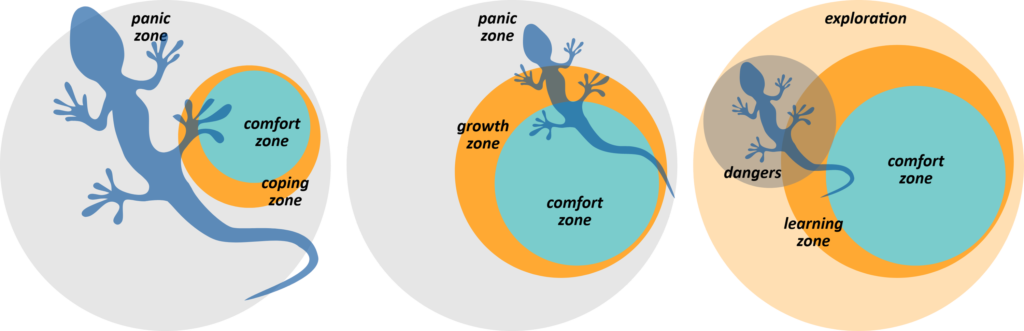
When we make the real shift in our worldview in the third stage (from a hostile/dangerous world to a friendly one), that doesn’t mean we naively believe everything is a bed of roses. But we have a clear picture (and good tools) of where danger lurks and where it doesn’t. We can spot danger from a distance.
In the remaining areas, curiosity drives us. There is a large area that is familiar to us, an area where learning brings us joy (learning comes from joy, not from necessity), and the rest is adventure and discovery.
In this third stage, our limbic system is active and in balance. We are in life mode, not survival mode. This applies to about 2% of people.
But there is no reason why we cannot be among them.
Leave a Reply