Actually, the question was “What is love?” or “How can I tell if I’m truly capable of loving (unconditionally)?”
And a) off the top of my head, it’s often not easy to explain (it’s more of a feeling), and b) in the business world, we still don’t like to talk about love.
What exactly are intelligent systems?
That’s why I ask instead, “What’s best for the system?” or simply, “What are intelligent systems?”
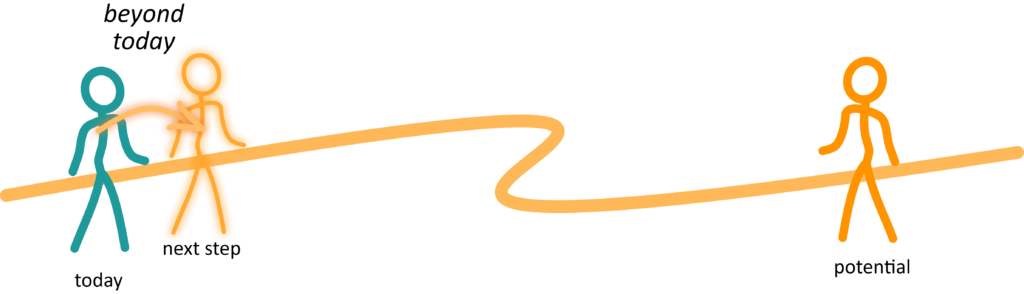
Every person is a system, too. We’re illustrating this in terms of people right now, but the same principle applies to any kind of system. If we break it down very simply, life is the period of unfolding—from today to one’s potential. Starting today, it’s always just about the next small step. “Tomorrow is beyond today.”
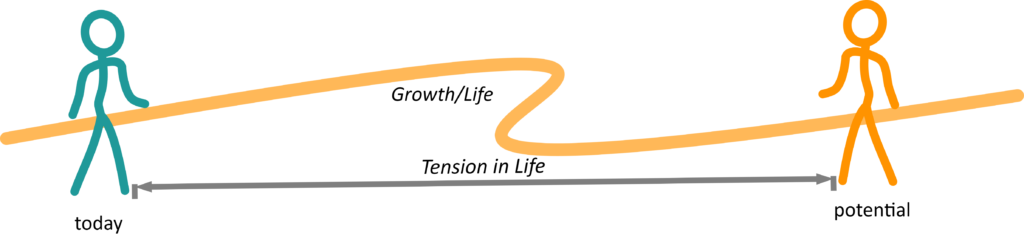
The gap between where we are today and our potential is our inner conflict, our tension. The wider the gap, the more tense—and thus the less relaxed, and therefore the more stressed—we are.
A note on the word “potential”
And “potential” is, after all, a somewhat difficult and overused word. Strictly speaking, it refers to the natural, fundamental state to which we return. The idea of the diamond. We as humans (or, indeed, systems) possess a uniqueness that has been stripped away from us. We see this in the diamond. The reason is a transmission of the worldview—from generation to generation—completely unconsciously.
“Potential” is not a fixed goal, but rather the idea that we are within our diamond, yet we enter into the friction. In other words, it is the interplay between the rough diamond and the polished gem. Life should be the process of polishing that transforms our rough diamond into a brilliant gem. Here, we use “potential” as a term for this polishing process. So we want to enter into this movement and unfolding and remain within it.
In a feudalistic culture, we are caught between the mold we’ve been forced into and our true potential. If we don’t set out to realize our “potential,” we’ll never truly begin living, because we’ll remain stuck in that inner tension and conflict. That’s why the next step is so important.
How do we even end up in such a tense state? We already explained that in 3x Diamond. For now, it’s enough if you just read Model 1. It’s just a short bit of text and a picture.
Our “I’m not enough” or “I’m too much”—which stems from Diamond Model 1—is this tension. It is the tension we constantly try to numb (external emotional regulation). It is the perceived discrepancy between who we are and who we should be.
And that brings us to the title: Intelligent systems try to minimize this state because it costs an enormous amount of strength and energy. Everything we waste on this inner conflict cannot be used for anything else. That’s pretty silly.
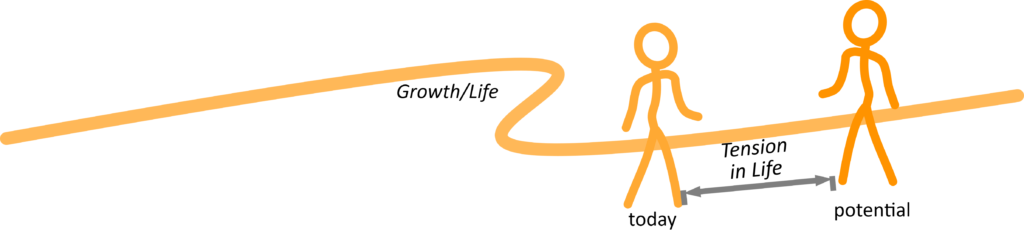
Intelligent systems avoid this tension from the very beginning. In other words, intelligent systems optimize to ensure that the gap between “today” and “potential” never becomes large, rather than—as we saw above—first making this gap huge for no good reason and then laboriously trying to close it.
So what about love?
“Judgment is not an action, but an attitude.”
Love is about one’s fundamental attitude. It’s about moving toward one’s potential. When I’m operating from a worldview of love, I look toward the next step. Toward the movement.
We see this in the act of judgment. If I say, “You’re a narcissist,” that isn’t necessarily judgment. The statement alone doesn’t give me enough information. It could be judgment, or it could simply be an assessment of the situation.
If I say it to describe your nature—that is, if I use it as a shield to create distance and put up a defense, thereby cementing you in that state—then it is judgment.
However, if I say the same sentence to create movement—that is, to take the first step from there—then it is merely an assessment of where we stand and love. Because we need a clear assessment of where we stand in order to get moving.
Narcissism and Depression
These two are just examples, of course, but these two mental illnesses or disorders in particular show that they share the same root cause. The gap between the present and one’s potential is enormous.
I’m giving up on this depression. I wish I could, but I just can’t hide it anymore and pretend everything’s okay.
Narcissism also crumbles under the strain. But instead of admitting it, he creates an entirely different world where everything makes sense again.
We can keep this in mind: Everything that moves me and others toward our potential is love; everything that freezes us in place (whether it’s the common habit of “judging others” or self-deception and self-defense) is not love.
“Moving toward one’s potential is love; anything else is not.”
We call a thousand other things “love.” These are all about external emotional regulation, because what matters to us is how we feel. Often, we just want to evoke (familiar!) feelings within ourselves.
Love and Relationships
For me, the best definition of love is still Gerald Hüther’s: “Love is the unconditional interest in the growth of the beloved.” That includes myself. And it’s not about self-care or feeling good, but about growth. In other words, moving toward one’s potential. And I can measure the success of love by my inner relaxation. And I see inner relaxation in the absence of resistance. Anyone who is constantly in external emotional regulation or resistance cannot be in love or self-love.
And that’s not a judgment, but an assessment of where I stand. Because once I know exactly where I stand, I can start moving forward.
When we talk about love, we usually mean the feeling of our own inadequacy (our “I’m not enough”) that we want to fill through another person. So it’s about using someone who makes us feel good. Or, more often than not, just a familiar feeling—the one we came to know as love when we were children. Our brain is very simple in this regard: familiarity comes first. Because, from this simple perspective, it’s “safe.” After all, we’ve survived.
That’s why this substitute love is often linked to desire, lust, excitement, butterflies in the stomach (which are actually signs of stress), the urge to possess, and more. You know how it is.
True love is unconditional. It is essential for a relationship, but it does not itself require a relationship. It is a way of seeing the world. We ask ourselves, “What is best for the system?” Where we can support that, we do so; otherwise, we at least try not to cause any harm.
In contrast, a relationship is never unconditional. A relationship begins when we see, hear, understand, and touch one another. So it can’t be all about me all the time. If I only have the other person in my life to get attention (or forgiveness, validation, …), then it’s not a relationship. The same goes if it’s only about the other person.
A relationship is the “system” in which we help each other meet our basic needs. The key is commitment. And commitment means, “Your needs are just as important to me as my own.”
Why the self-deception?
If we haven’t learned to love ourselves, then we want to protect ourselves. To defend ourselves. Both as a substitute for true security. The resistance stems from shame. And the shame comes from the fact that we feel we have lost ourselves (and that there is no way back). And because we are convinced there is no way back, we don’t even set out. We think we’ve lost ourselves, our identity. We can learn even more roles, but we’re gone. And we’re ashamed of that. We’re gone and still not enough and not right. That’s why we try to convince ourselves and the world that everything is okay. That we’re living up to our potential.
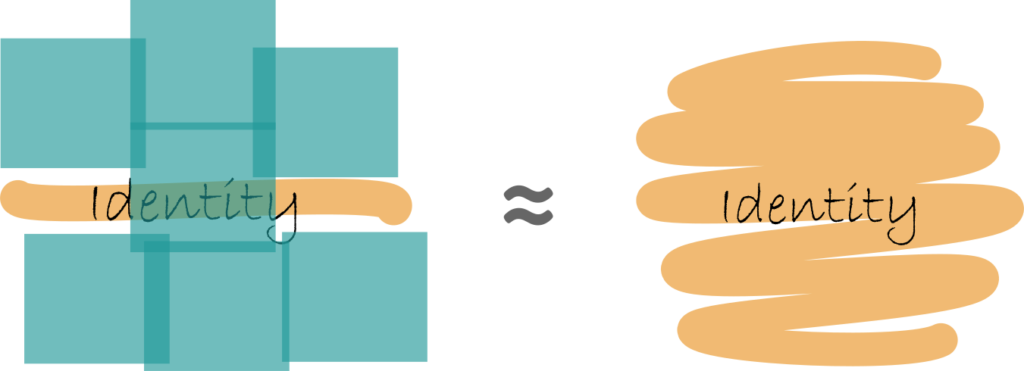
The Misconception About Self-Care
If we think of self-love in terms of self-care or feeling good, we’re still on the wrong track. These things are totally fine—there’s nothing wrong with them—but they have nothing to do with love.
It’s more than just wanting to be “kind to ourselves.” And kindness is almost always the opposite of love. Because kindness is comfortable. It’s about creating feelings that are familiar and pleasant to me. In our view, that amounts to stagnation.
Feeling good is a reliable guide when I already have a functional worldview. When my life is such that I say, “Everything is okay, and I want more of this.” Then that’s fine. Because our brain—always looking to conserve energy—repeats what it knows and what has worked. The only relevant criterion here is: “Did we survive that?” Everything we’ve survived is okay, even if we found it very unpleasant. (See also Comfort Zone 2.0)
This can lead to the paradox where our self-care routine actually ends up making us feel very uncomfortable in the long run. We remain stuck in the pain. Then self-care becomes nothing more than a external emotional regulation and a distraction. We stay sitting in the cesspool (instead of getting out and taking a shower), but hang up a few air fresheners and place a few houseplants around. We make our suffering cozy.
Resistance as a Gift
“Resistance reveals everything we would never dare to ask.”
This applies to our own resistance as well as that of others. Whenever we encounter resistance (and it can take many forms), it is an opportunity to understand—to see and understand ourselves or others.
Some Faces of Resistance: Attack | Defense | Justification | Escape | Blockade | Distraction | Rejection | Condemnation | Defiance | Irony & Sarcasm | Victimization | Drama | Sabotage | Ghosting | …
And each one tells its own story. It serves as a guide.
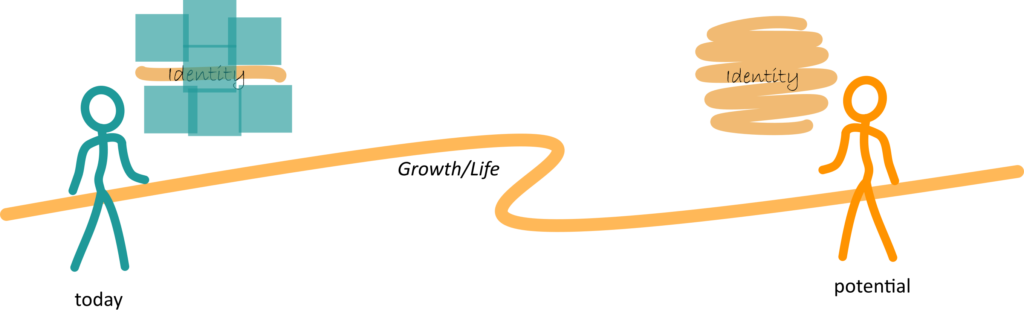
And resistance primarily reveals the tension—that is, the gap between reality (today) and how we would like to be. Or how we think we should be.
The root of resistance is that we judge ourselves but want to hide it. So we can’t escape this dilemma as long as we judge ourselves. But we judge ourselves as long as we believe we aren’t good enough.
Is there a way out?
Now it’s time to finish reading 3x Diamond. Our worldview is just a picture. It isn’t real. We can, should, and are free to reshape it at any time.
And the quality of a model is always only as good as the scope for action it creates. The greater the scope for action, the more intelligent (better) the model.
So just relax—reduce the inner tension. It used to seem impossible, but it’s actually quite simple. And be patient with yourselves. At first, loving yourself feels unfamiliar.
Leave a Reply