The Hidden Deficit: Why (Almost) All of Us Are Emotional Vampires

Why You Might Be More “Toxic” Than You Think

Let’s start with a hard truth—one that most of us instinctively deny:

If you’re operating from a deficit, you are draining others—no matter how kind, smart, or well-intentioned you are.

You might recoil at the word “toxic.” You might think of manipulative colleagues, emotionally unstable partners, or controlling parents. But what if that term applies to you—and me—in subtle, unspoken ways?

This isn’t about blame. It’s about understanding. And if you’ve ever felt unseen, disconnected, exhausted, or perpetually searching for something “more,” this might just explain everything.


What Is the Deficit—and Why It Makes Us Emotional Vampires

The deficit is an inner emptiness. A sense of lack. A subtle feeling that something essential is missing—and that it’s just out of reach.

When we live from this deficit (which 98% of us do), we become emotional vampires. We don’t mean to, but we pull energy from others—our kids, our partners, our teams. Not through malice, but through need.

This deficit shows up as:

  • Always needing reassurance
  • Overreacting to small things
  • Getting defensive or controlling
  • Avoiding vulnerability
  • Never really feeling “here”

It’s not about being bad. It’s about being disconnected—from yourself, and therefore from everyone else.


The Subtle Signs—Especially With Children

Want to see this dynamic in action? Look at how you hug a child.

Are you fully present—or just going through the motions?

When you’re in deficit, your heart and soul are inwardly circling around your own emptiness. Your arms may be embracing, but your presence isn’t. Children feel this immediately.

Their brains might register, “Nothing’s wrong,” but their nervous systems scream, “Something’s not right!”

Their limbic brain says: “This isn’t safe.”
Their Gecko brain (the primal brainstem) goes into alarm mode.

And here’s the kicker: when parents don’t connect emotionally, children feel existentially unsafe. That fear—the fear of emotional abandonment—becomes their default setting for life.


This Fear Shapes Everything

That primal fear of being unloved, unworthy, or abandoned drives nearly all human behavior:

  • Overworking
  • People-pleasing
  • Power games
  • Control issues
  • Withdrawal or burnout

This fear hides behind anger, perfectionism, jealousy, and ambition.
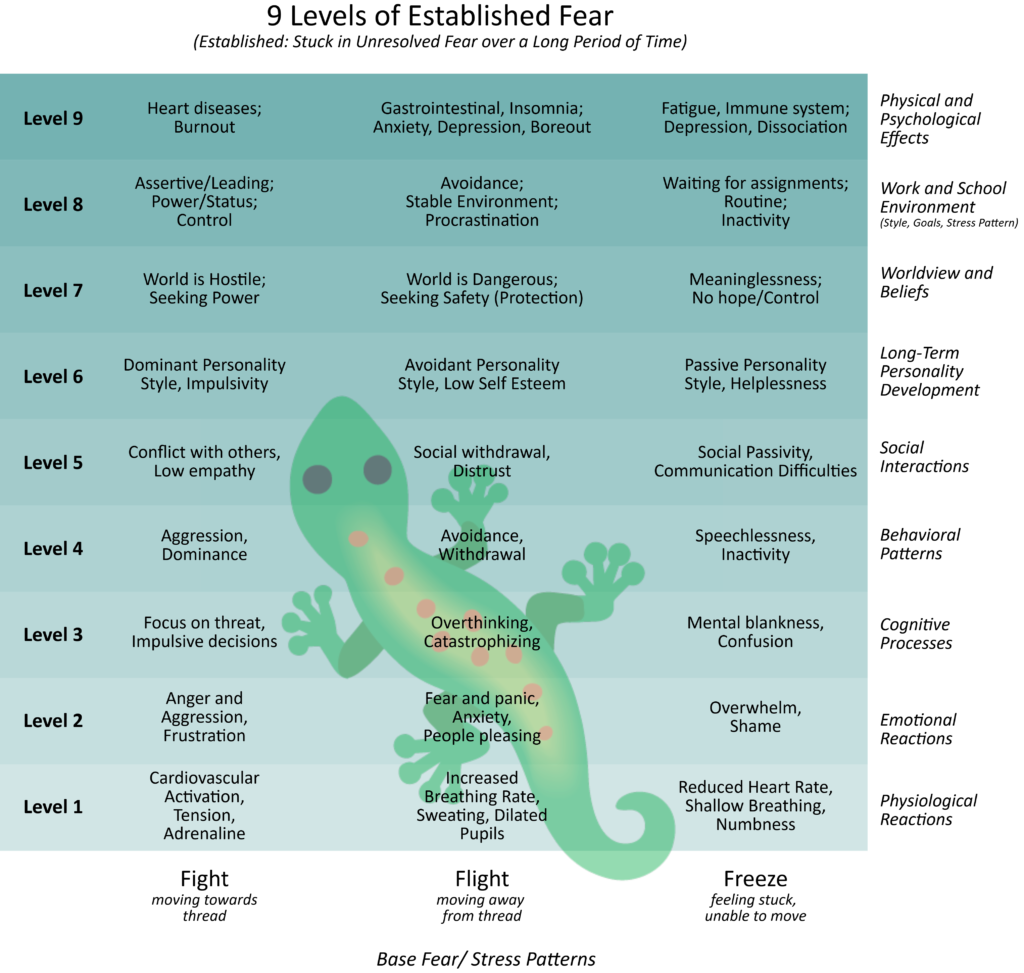
Once you start to see it, you see it everywhere.

And that’s why we need to learn the patterns—so we can change them. That’s why tools like the Gecko-Cheat-Sheet (🔗 OrgIQ_GeckoCheatSheet_Release_EN) are so important. When you see the fear behind someone’s reaction, you can respond with compassion, not counter-attack.


The Numbers (and Why This Is “Normal”)

The Tribal Leadership data from 2010 still holds up:

  • 98% of people are living from a deficit state
  • 76% of them don’t even realize it
  • 22% are starting to wake up—and take steps toward healing
  • Only 2% live in inner peace and have truly healthy, functional relationships

Let’s put this into perspective.

You probably have about 5 close relationships and 10 more casual ones. That’s 15 people. (Based on Dunbars 2018 number.)
Statistically speaking, it’s highly unlikely that any of them are part of the 2%. That means your normal is dysfunction—but you’ve never seen anything else.

So when we talk about “toxic behavior” or “emotional dysfunction,” we must understand:

It’s not the exception. It’s the norm.

Most of what we call “toxic” is just ordinary deficit—expressed in different ways.


Why This Isn’t Hopeless—It’s Hopeful

Realizing that you’re in a deficit doesn’t mean you’re broken. It means you’re human. It means you’re now aware—and awareness is where freedom begins.

Healing doesn’t happen overnight, but it does happen. The more you recognize the patterns of fear, the more you can:

  • Stop draining others
  • Reconnect with yourself
  • Choose presence over performance
  • Give without needing a return
  • Love without fear

The goal isn’t perfection. The goal is presence. And from that place, real connection becomes possible.


You Are Not Alone—And You’re Not Hopeless

If you’ve read this far and thought “Oh wow… that’s me,”—you’re not alone. You’re not broken. And this is not your fault.

It’s just the result of a culture and system where almost no one was truly present for us—because no one was present for them either. It’s not about blame. It’s about breaking the chain.

Start where you are. Be curious. Be kind—to yourself, and others.

Because when we heal the deficit, we don’t just stop being emotional vampires.
We become sources of light—for ourselves, our children, and everyone we meet.

Comments

28 responses to “The Hidden Deficit: Why (Almost) All of Us Are Emotional Vampires”

  1. AI Logo Generator Avatar
    AI Logo Generator

    The part about hugging a child while emotionally absent really struck me. It’s a subtle but powerful example of how we can seem present while actually being wrapped up in our own inner lack. It’s made me rethink the quality of my daily interactions, especially with those closest to me.

  2. Photo to Coloring Avatar
    Photo to Coloring

    It’s humbling to realize how easy it is to slip into patterns of needing others to fill our internal voids, even without meaning to. The part about hugs really hit me—so simple, but such a clear mirror of how present (or not) we really are.

  3. Ghibli Art AI Avatar
    Ghibli Art AI

    It’s sobering to realize how often we seek connection from a place of lack rather than presence. I’ve definitely caught myself hugging my child while mentally spiraling elsewhere—this post was a wake-up call.

  4. 4o Image API Avatar
    4o Image API

    I appreciate how this piece avoids blaming and instead opens up space for self-inquiry. That example about hugging a child while being emotionally absent was striking—it made me pause and rethink my own presence.

  5. 4o Image API Avatar
    4o Image API

    The metaphor of being an emotional vampire without realizing it is powerful. It reframes ‘toxic’ behavior as a symptom of disconnection rather than a moral failing, which feels both humbling and strangely hopeful.

  6. Veo 3 AI Avatar
    Veo 3 AI

    This post really made me think about how often I’m seeking reassurance without realizing it. I never considered how that could actually pull energy from others instead of creating a more supportive atmosphere.

  7. Veo 3 API Avatar
    Veo 3 API

    This really made me pause—especially the part about how we hug our kids. I hadn’t realized how often I’m physically present but emotionally preoccupied. It’s a humbling reminder to check in with myself before expecting connection from others.

  8. Nano Banana AI Avatar
    Nano Banana AI

    What really struck meBlog comment creation here is the idea that most of us are draining others without realizing it, not because we’re malicious but because we’re operating from our own lack. It makes me wonder how often I’ve shown up to interactions half-present, thinking I was giving, when in reality I was subtly taking. The reminder that connection starts with being grounded in ourselves feels like a powerful (and humbling) starting point for change.

  9. Nano Banana API Avatar
    Nano Banana API

    I appreciate the idea that being ‘toxic’ doesn’t always look like manipulation or overt control—it can just be a subtle sign that we’re disconnected from our own needs. I think recognizing this is the first step toward real change.

  10. Banana AI Avatar
    Banana AI

    I never thought about it like this before, but the hugging example really got me. Gotta be more present

  11. GemPix 2 Avatar
    GemPix 2

    This really struck a chord with me. I never thought about how an emotional deficit can create such subtle but draining behaviors. The example of hugging a child really opened my eyes to how I might not always be fully present with those I love.

  12. AI ASMR Avatar
    AI ASMR

    The mention of hugging a child while being emotionally absent really struck me. It’s a subtle yet impactful reflection on how often we are physically present but mentally distracted; it’s made me reconsider how I engage with people daily.

  13. demumu Avatar
    demumu

    This idea of the ‘deficit’ really resonated with me—especially how it shows up in small, everyday moments like hugging a child or reacting to minor frustrations. It’s a powerful reminder that emotional drain often isn’t about malice, but about our own unmet inner needs. Thanks for framing this so honestly; it’s easy to overlook how we might be unconsciously draining others without realizing it.

  14. MorseCodeGen Avatar
    MorseCodeGen

    Framing this as a structural ‘deficit’ rather than a personal failing is such a helpful shift; it removes the shame and makes the work of self-regulation feel much more actionable. The point about hugging a child really stopped me in my tracks—it is a visceral reminder that we cannot give from an empty cup.

  15. Voe Ai Avatar
    Voe Ai

    The hugging example really struck me. I often find myself going through the motions without truly being there. It is a humbling reminder that I need to fill my own cup first before I can genuinely show up for the people I care about.

  16. create music videos Avatar
    create music videos

    This article made me stop and think about how many times I’ve been physically present but emotionally distant, especially with my child. The image of hugging while being absent inside really stayed with me. It’s a humbling reminder that real connection begins with being grounded in ourselves first. Thank you for sharing this perspective.

  17. photo to video ai free Avatar
    photo to video ai free

    This article really made me pause and reflect. The example of hugging a child while emotionally absent hit home — I’ve definitely been there, giving physical presence without real connection. It’s humbling to realize how often we drain others simply because we haven’t filled our own cup first.

  18. create music videos Avatar
    create music videos

    Reading this made me reflect on moments when I’ve held my child but wasn’t really present—physically there but emotionally elsewhere. It’s a humbling reminder that when we run on empty, even our most loving gestures can feel hollow. I’ve been exploring creative ways to reconnect with my genuine self, and something like an AI-powered video creation tool has been a surprisingly helpful outlet to express what’s really inside rather than just going through the motions.

  19. photo to video ai free Avatar
    photo to video ai free

    This really made me think about those moments when I’m physically holding my child but emotionally somewhere else—true presence is harder than it sounds. Something like this could help bridge that gap by capturing family moments in a way that reminds us to actually show up, not just be there. Tools like photo to video AI that make visual storytelling more accessible are a quiet but powerful way to reconnect with what’s in front of us.

  20. ai hd photo converter free Avatar
    ai hd photo converter free

    This really made me reflect on how often I’m physically present but emotionally checked out, especially with my kids. The example about hugging them while distracted hit home – it’s those small absences that add up. I want to be more intentional about actually being there in the moment, and that includes preserving those real connections clearly – whether in memory or in photos of genuine moments together.

  21. MOV to MP3 converter Avatar
    MOV to MP3 converter

    This really hit home—especially those moments when I’m hugging my child but mentally elsewhere, like I’m running through tomorrow’s to-do list while physically present. I’m trying to document my own reflections on presence more intentionally now, and converting video thoughts into audio has become a surprisingly useful way to process these realizations without getting lost in the visuals.

  22. try2fa Avatar
    try2fa

    The distinction you make between malice and a simple inner deficit is incredibly insightful; it shifts the focus from judging behavior to addressing the root cause of emotional exhaustion. I found your observation about how this ‘deficit’ manifests even during intimate moments, like hugging a child, to be a powerful reminder to check our own presence rather than just our intentions.

  23. ASCII Art Generator Avatar
    ASCII Art Generator

    This really made me reflect on those moments when I’m physically present but emotionally absent—like when hugging my child while my mind is elsewhere. I think creative outlets like ASCII art can actually help us process these feelings and become more aware of our inner lives. Thank you for such a thoughtful and vulnerable piece.

  24. The hugging-your-child example really cut deep — I’ve absolutely been that parent, arms around my son while my mind drifts to tomorrow’s meetings. Lately I’ve caught myself scrolling old family photos, even animating a few into short clips, hoping motion would somehow recover what I wasn’t fully present for in the first place. It doesn’t, of course; sitting with that inner emptiness instead of quietly feeding off the people I love feels like the harder, more honest work. Thank you for naming this so plainly.

  25. The hugging example really landed for me — I’ve caught myself holding my kid while my mind was already three rooms away, and calling that “presence.” Lately I’ve been trying to give my unprocessed feelings somewhere to go before I show up to the people I love, sometimes by journaling, sometimes by turning a song that’s been looping in my head into a small video just for myself. It’s not therapy, but externalizing that inner static seems to leave a little more room to actually be there when it counts.

  26. Voe Ai Avatar
    Voe Ai

    This really struck a chord with me. The example of hugging your child while being emotionally absent is something I have caught myself doing more than I would like to admit. Thank you for naming this so honestly.

  27. The line about hugging your child while being emotionally somewhere else really landed for me — I’ve caught myself doing exactly that more times than I’d like to admit. Lately I’ve been pulling the audio out of old family MOV clips just to listen back to my kids’ voices on walks, and it’s quietly shown me how often I was “there but not there.” Thank you for naming something so uncomfortable in such a plain way.

  28. The hug example really got me — I’ve definitely been physically present with my son while my mind was already three tasks ahead. It’s strange timing too, because I was just trying to clean up some old blurry family photos this week, and it hit me that I can sharpen the images but not the moments I wasn’t truly there for. Thank you for naming something so uncomfortable so gently.

Leave a Reply

Your email address will not be published. Required fields are marked *