The “diamond” model actually predates the “Hamster wheel”; in other words, they are simply variations of the same concept.
All models are wrong. Some are useful. The original version of the diamond model or hamster wheel was meant to be nothing more than a metaphor for our inner world—to explain our potential, our inner pain, and the roles we play.

It does not describe reality, but rather presents something complex in a simplified, visual, and tangible way. And in that sense, this model is also a worldview. It can explain something, and depending on the quality of the explanation, it also provides room for action.
Let’s take a look at variations of the diamond model and see how the problem space and solution space (room for action) change.
Model 1:
We are our own raw diamond. That’s how we come into the world. That’s how we want to be seen and accepted.
And of course, we need a polishing process to turn us into a brilliant diamond one day.
But instead of polishing us, people go and say, “Look at what you just did/said/thought/felt—that’s wrong. Don’t be like that anymore.”
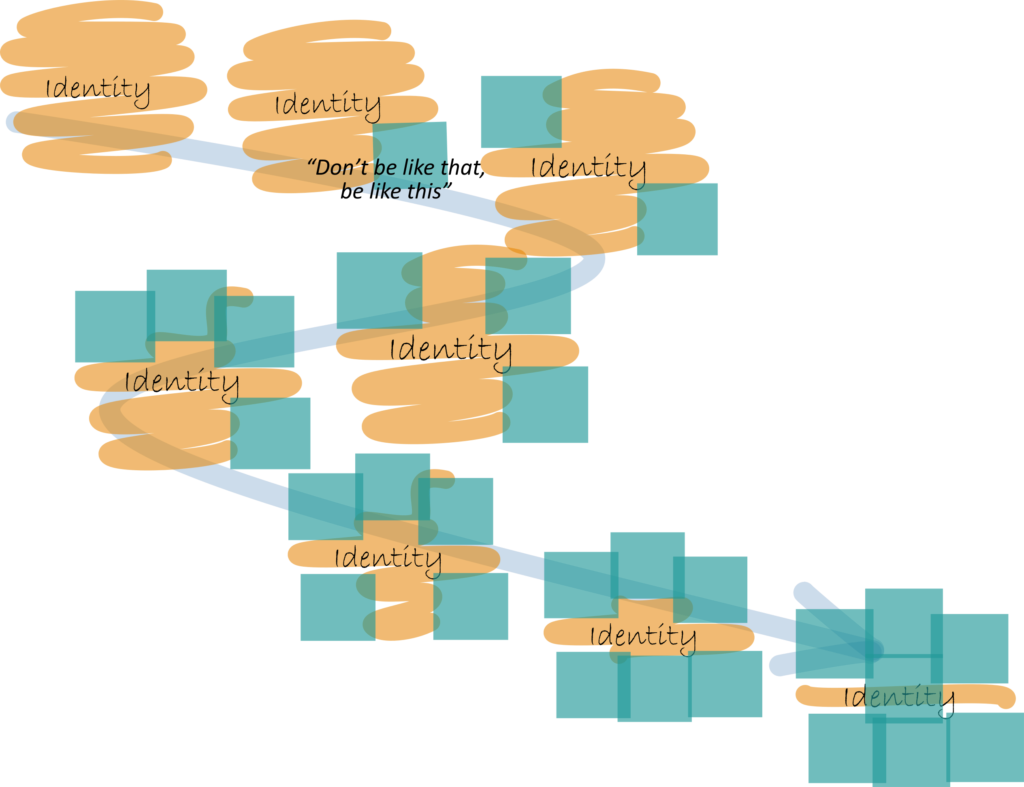
What happens then is that a piece breaks off our diamond and is replaced by a conformist piece of plastic.
Over and over again, until we’re nothing more than a plastic block, just like everyone else. We conform to the standard. Our identity has dissolved, and we’re now made up entirely of the standardized, conformist pieces we’ve been turned into.
And in some moments, we try to build up at least a little identity on the outside (clothes, car, hobbies, …).
But there’s no going back.
Model 2:
Here, too, we start with our raw diamond (as a baby). And it, too, wants to be seen and accepted. But sooner rather than later, we face rejection: “You’re wrong.” You’re not enough, or you’re too much.
Each of these rejections is as if our diamond were to fall into a huge pile of poop. That’s exactly how it feels. Then we pull the diamond out of the pile, but a crust of poop always remains around it. Layer by layer. And when we look inside ourselves, all we see is poop (in the image, the doubts).
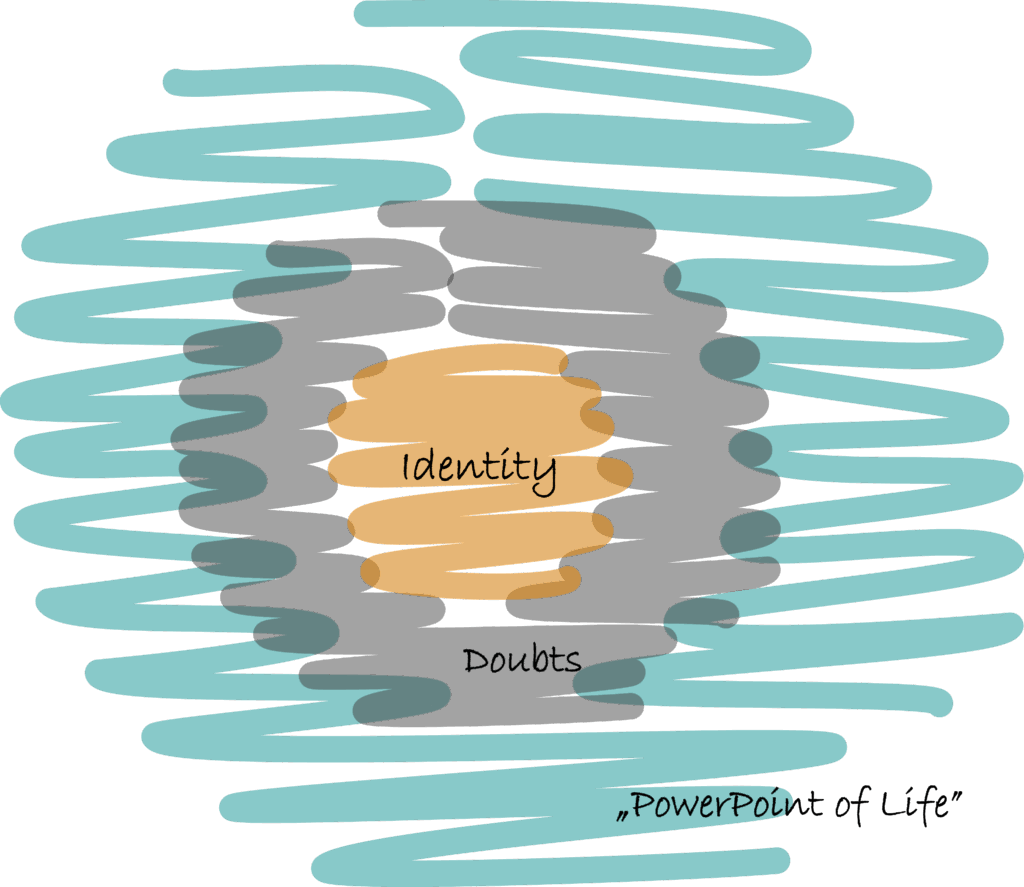
But we’ve been told how we’re supposed to be. So every rejection is a form of programming: Don’t be yourself, but be like xyz.
The rejection is the crust of poop, and the instruction is a role we slip into. A decorative coat of paint we spray over the poop so that we at least look good on the outside. (The “PowerPoint of Life”—at least on the slides, i.e., on our social media—life looks good.)
This model is a bit more precise. We take a closer look at what’s really happening inside. And we know that with buckets and sponges, we can uncover the diamond again. It’s tedious and unpleasant because we have to wade through the crap all over again, but it’s possible.
And we also see that neither the crap nor the decorative layer is our identity. That lies in the diamond.
Model 3:
Here, too, we start out as raw diamonds and want to become brilliant gems in our lives. We seek belonging and acceptance. The fulfillment of our basic needs.
Here, too, we experience rejection. And the feeling of “I’m not good enough” arises.
But here, we take a closer look. What really happens in rejection? What role do we play?
What is missing in Model 2 is our consciousness. Our inner observer. We think (and feel) that our consciousness is our “I,” but in fact, it is only a small part. The area that we consciously perceive and control.
Depending on the source, 99.999% of data processing passes us by. It’s like a smartphone: our consciousness is just the user interface. We see what appears on the GUI. Everything else remains hidden from us. And most of it is handled for us in the background.
While as babies we still see the diamond on the user interface, with every rejection it becomes less and less visible. Other things (namely, how we’re supposed to be) push their way in. Our conscious thinking learns roles and the right answers. It’s like in the theater: We slip into the role, because every rejection contains the script for how we’re supposed to be.
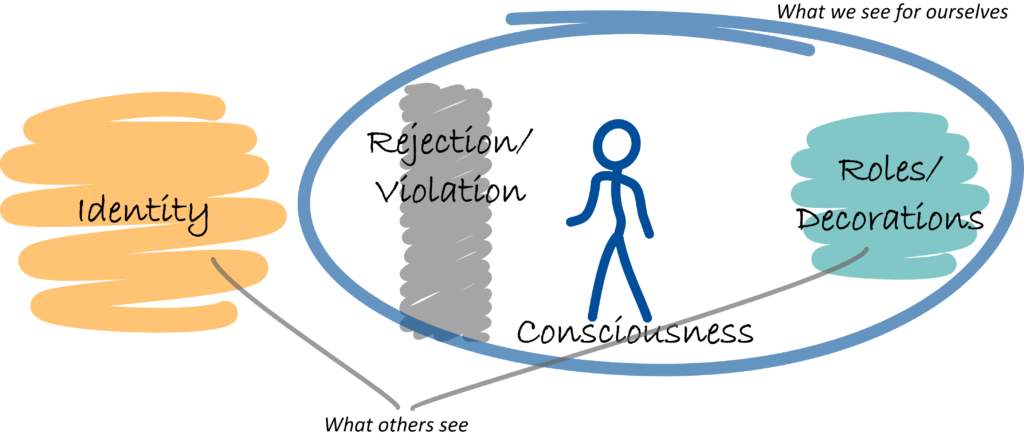
So we emulate the “expected” persona, because everyone is supposed to think that’s who we are. And if our audience changes, we change the role. The main thing is to get applause.
So, much like in Model 2, we have the rejection that blocks our view, and the role we project to the outside world. But it’s not crusts of poop; rather, it’s walls or cardboard cutouts of piles of poop that stand between us as observers and the diamond.
And that’s the small part we see. Worldview means: What does my consciousness see, and how does my consciousness see the world?
Just because we’ve become blind to it doesn’t mean our diamond has disappeared. There are always situations where others can see and experience our diamond.
Beyond what we do to ourselves so that we can live in the absence of the diamond and the cardboard cutouts of turds, there is another, much greater reality. We see ourselves as in Model 2. But others can see much more of us.
There are even polishing processes taking place on our diamond that completely pass us by.
In this model, healing is above all a shift in perspective: our consciousness simply needs to change its vantage point. Everything can be present at the same time. Yes, we were rejected. Yes, we slipped into roles. Yes, our identity is there all the time and is also active.
And with this perspective, we can let the wounds remain as past experiences, but they hold no significance for the here and now. We don’t necessarily need the roles. We can decide if and when we want to play them. And we can observe and marvel at what our diamond is doing (and has been doing all along) without us having to worry about it.
The lesson in the models?
We can see that the models are becoming increasingly unwieldy and complicated. More layers and more perspectives.
But this also changes the space of solutions.
In Model 1, there’s no turning back. The diamond is lost, and we’re nothing but plastic now. A copy. No way back. So let’s just close our eyes and plunge ahead—we’ve wasted our lives. Zombie mode.
In Model 2, we have the option of using a bucket and a sponge to wash away the crusts of poop. They won’t disappear completely, but the diamond will be revealed. It’s hard work, it’s unpleasant, but we rediscover our lives.
Model 3 takes a completely different approach. So the rejection we’ve experienced is real. We don’t need to question that. But it’s actually meaningless. It hasn’t changed us. Our diamond is just as beautiful and radiant as before. Only that small part of us—our consciousness, the 0.001% of conscious data processing—has put on these “I’m not enough” glasses and is looking at us exactly the same way as the people who rejected us.
Important: Our inner critic sees us as no worse than the sum of all the rejection we have experienced.
That is not how other people see us.
Rejection stems from our own self-doubt. So our self-doubt is a collection of all the doubts held by the people we have encountered.
Those who saw the diamond within us that they had to suppress. So they wanted—in the spirit of painful fairness—for us to suppress it too.
But as soon as we take off the glasses and change our perspective (our point of view), we see ourselves clearly again. We don’t have to change anything within ourselves; we just have to see ourselves fully once more.
This allows the wounds to recede into the background. Faded memories of rejection. From people who themselves were always rejected and knew nothing else. But alongside that, everything else about us is there at the same time. Bigger, more alive, more present.
3 ways to see our inner selves. And different ways we deal with hurt.
Model 4: “Worldview in Progress”
And now let’s go back to the beginning. These are all just images. Neither right nor wrong. Each has its limitations. Each has its costs and benefits. You’ll likely recognize certain aspects in one of these images—moments when you think, “Yes, I know that.”
And since they’re just images, you can choose the one that fits you best—or, better yet, build one that fits. You now have some basic elements. You can leave out what doesn’t help you, or add elements that you’re missing.
Your model can change over time or be adapted to different situations. A “worldview in progress.” And the model should explain your story to you, allow you to make predictions about the future, but above all give you as much freedom of action as possible in the here and now.
Have fun with it.
(For more on its application, see “Intelligent Systems Are Relaxed.”)
Leave a Reply