STORY ABOUT INVISIBLE FORCES
How the outside moves inward — and why leaving alone does not set us free
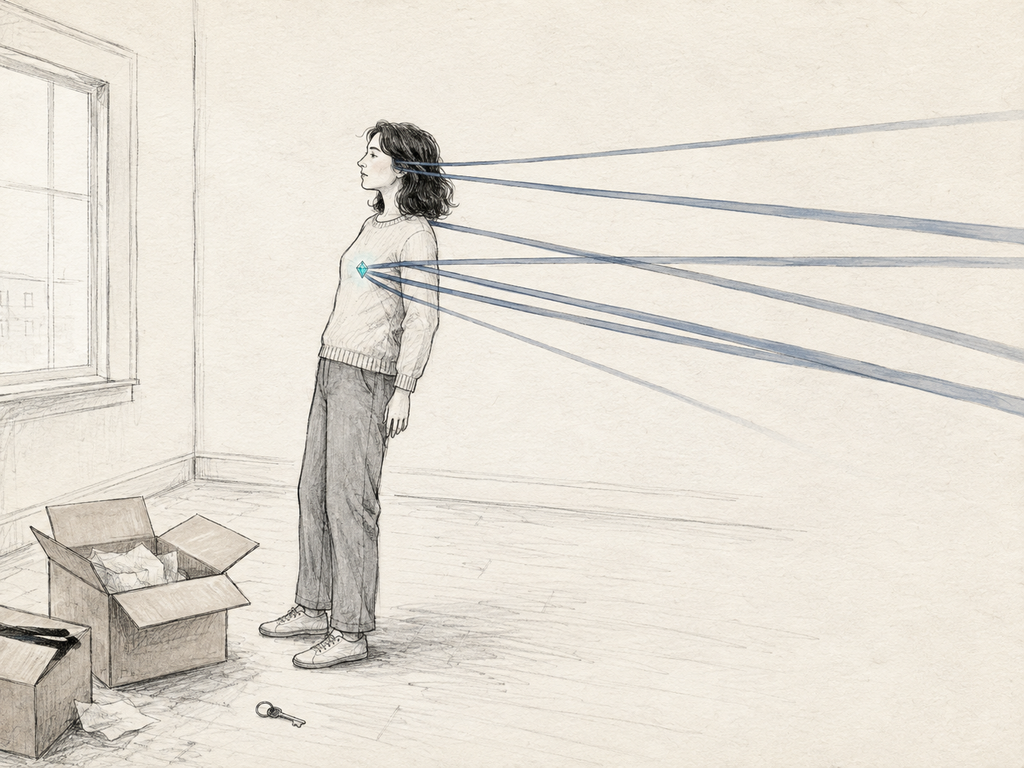
The people are gone. The direction remains.
Alena thought freedom had an address. Alena’s story in any universe.
(The story is mine—or rather, yours. As always, there are countless names behind it. The images, however, are from my AI.)
The New Apartment
Alena thought freedom had an address. A different street, a different city, perhaps simply a door she could close behind her. So she moved. She left the job where every day consisted of tasks that only produced more tasks. She saw less of the people who made her feel smaller after every conversation. She bought a new table, put a plant by the window, and resolved that from now on she would do only what truly mattered to her.
On her first morning in the new apartment, she woke at 6:12. No one was waiting for her. No alarm had gone off. No message was flashing on her phone. Still, she got up at once and wrote a list. While the coffee brewed, she was already ashamed that she had not accomplished anything. By eight o’clock she was exhausted, although her new day had barely begun.
Alena looked around. The people who had always pushed her were not there. School had ended long ago. Her former boss did not even know where she lived. And yet her body was as tense as if invisible rubber bands were pulling at her from every direction.
For the first time, she understood: she had left the place, but the direction had come with her.
Before Alena Learned to Function
When Alena was born, she did not have to achieve anything. She did not have to be useful, tidy, punctual, or sensible. She was there — and her being there was enough to make people smile. When she cried, someone came. When she found a face, a face looked back. When she reached out, she touched something warm.
This is how the first rubber bands form. They connect us to people and experiences. Some say: you are seen. Others: you are heard. You are allowed to feel. You are allowed to try. You belong. These bands do not pull us away from ourselves. They pull us deeper into life.
But before long, other bands appeared. Not out of malice. Most came from worry, exhaustion, or the hope that life might one day be easier for the child. “Do it properly.” “Don’t be so loud.” “Hurry up.” “Don’t disappoint me now.” And sometimes the especially potent combination: be the way we need you to be — then you can feel our closeness again.
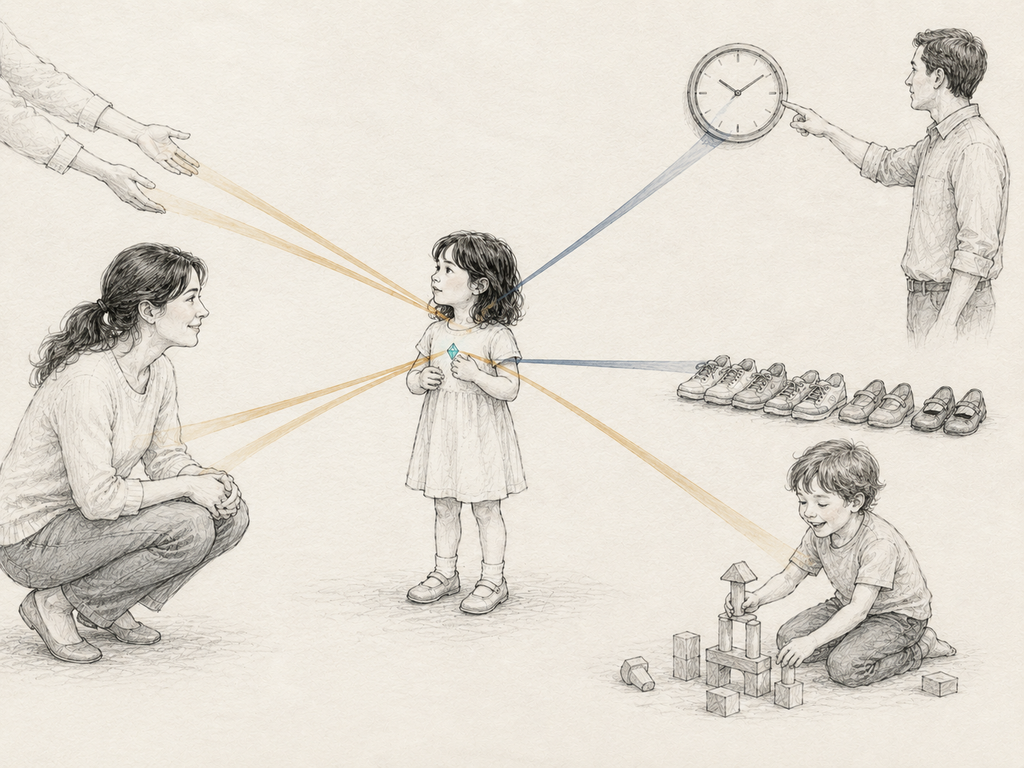
At first, many bands pull us toward life. The first bands of functioning appear later.
None of these experiences, on its own, became Alena’s worldview. It was only one data point. But children collect data with great seriousness. They must work out what kind of world they live in and what they need to survive there. What happens often becomes probable. What reliably brings closeness becomes a strategy. What reliably prevents pain comes to seem sensible.
This is not a malfunction. It is an astonishingly intelligent adaptation. A child cannot recalculate the world at every encounter. From repetition, it builds an inner map. That map does not have to show the whole world. At first, it only has to work in the world into which that child was born.
“That’s Just How the World Is”
At school, the blue-gray bands multiplied. There was the clock that decided when Alena was allowed to be tired. There was the chair on which her body was expected to stay still while her mind was somewhere else entirely. There were assignments with one correct answer and adults with little time for how Alena had arrived at it. Through homework, control reached all the way into her bedroom.
This does not mean that school has to be opposed to life. Learning can be curious, connected, and wildly alive. But in Alena’s experience, much of it pulled her not toward learning, but toward functioning. Sit beside others, but do not talk to them. Have questions, but follow the plan. Want to understand something, but finish first.
At the same time, another pull remained inside her: the wish to be seen, heard, understood, and touched. The sense that she had not come into the world to become a machine that caused as little disruption as possible. Sometimes this wish found an external anchor: a friend who truly listened. A teacher who did not ask whether her answer was correct, but what she had noticed. An afternoon when no one turned her play into a learning objective.
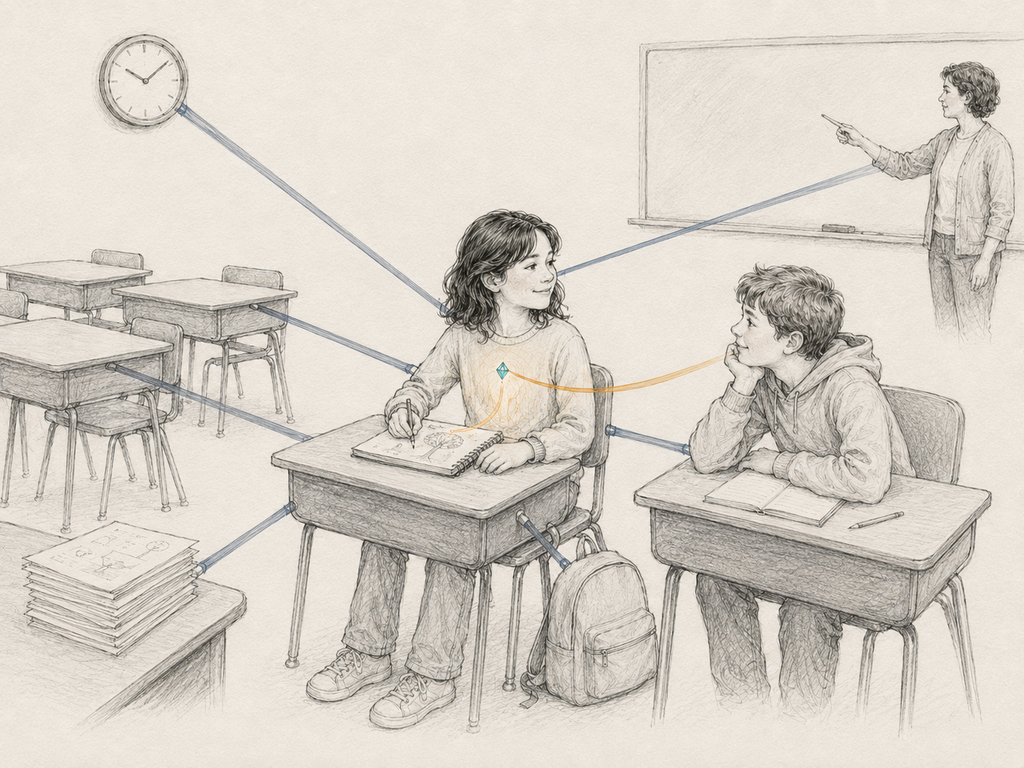
Over time, functioning becomes the stronger external reality. The warm connections do not disappear at once.
For a while, the two worlds remained in balance. Consciously, Alena knew quite well what she wanted: to be alive, to belong, to bring something of her own into the world. But the reality she lived increasingly supplied different data. Not “You are a gift,” but “You are right when you behave correctly.” Not “Your feelings are telling you something,” but “Your feelings are getting in the way right now.”
This is how inner tension arises. Our conscious mind can still point toward life while our experience pulls toward functioning. We begin to mistake our longing for naïveté and our protective strategy for reality. “It would be nice,” we say, “if the world were different. But we know what it is really like.”
The Move Inward
The decisive change happened quietly. No one sat Alena down and said: today we are going to internalize your world. There was no clear transition, no moment she could later remember.
At first, the sentences came from outside. Don’t be so sensitive. Don’t make things so difficult for everyone else. Try harder. Don’t make yourself the center of attention. Eventually, no one had to say them anymore. Alena heard them before she even tried something. She corrected herself before anyone else could. She withdrew her own permission before anyone could deny it.
The external rubber bands had become internal ones. Relationships had turned into predictions. Repeated experiences had condensed into beliefs — not merely sentences in the mind, but directions of pull throughout the whole system. “You are not enough.” “You are too much.” “You have to earn closeness.” “If you allow yourself to hope, the disappointment will only be greater.”
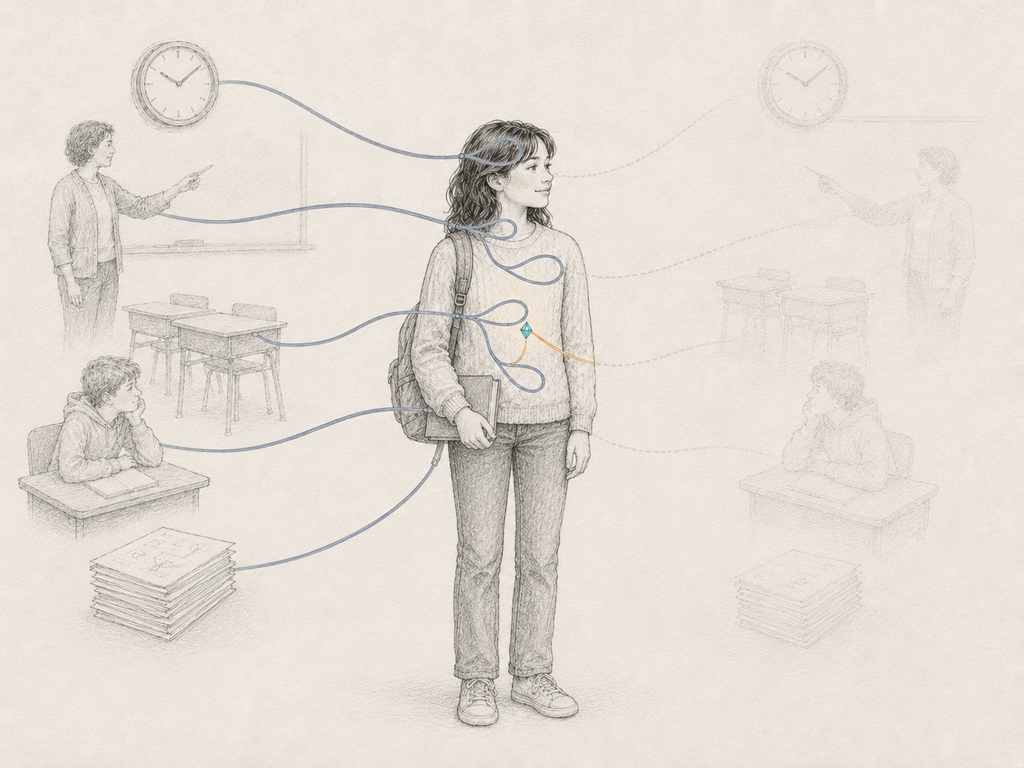
Internalization: the external anchors fade. Their direction becomes an internal prediction.
Precisely because this process makes sense, it remains invisible. Alena did not learn some arbitrary world. She learned the world that met her consistently. In a different environment, her brain would have strengthened different abilities and pruned different possibilities. It does not keep everything in storage just in case. It strengthens what is needed and lets go of what remains unused.
That is why life-giving relationships in childhood and adolescence are so precious. During these years, an external presence can especially easily become an inner voice. A person who truly sees us is not merely kind for one afternoon. They provide data for a different world. They can become an internal anchor: perhaps I really am here. Perhaps I am allowed to unfold. Perhaps connection is possible without abandoning myself for it.
There is no hard age limit for this. No one is finished at sixteen or lost at twenty-five. But early, frequent experiences get a head start. Later, new experiences must contend with a model that has proved itself a thousand times over. Change remains possible — it simply takes more than a good explanation and usually more than one good person.
The Love of the Zombies
Alena eventually began to call the world of pure functioning the zombie world. Not because the people in it were cruel or foolish. Quite the opposite: many were kind, responsible, and self-sacrificing. “Zombie” did not describe a person, but a state: functioning without truly feeling alive anymore.
Almost no one saw themselves as a zombie. Everyone wanted life. Many felt like victims of the hamster wheel — while passing its logic on to their children, colleagues, and partners. Not out of hypocrisy, but because functioning had become their only reliable survival strategy.
When parents or teachers like these communicate “Do not live,” they often mean something far more tender and sad: do not get hurt. Do not hope too much, and there will be less for anyone to take from you. Do not show all of yourself, and rejection will not strike your real self. Do not ask for genuine closeness, because people leave anyway. Make peace with the seriousness of life before life forces you to.
This is their form of love. They are trying to protect children from a pain they themselves do not want to feel again. The problem is this: numbing the feeling of hunger does not satisfy the hunger.
Deep beneath the protective layers, something in Alena remained that could not be completely retrained. Her diamond — her unmistakable identity, her particular combination of perception, longing, and gift. It was not always loud. Sometimes it was only the quiet sense that life had to be more than the successful avoidance of disappointment.
Resignation’s Quiet Peace
For a while, the bands pulled in different directions. Alena wanted closeness and avoided it. She wanted to create something of her own and first checked whether it would be worth it. She wanted to be seen and showed only the parts likely to meet with approval. The tension hurt.
Then things grew quieter. Not because Alena had found what she was looking for, but because the bands pulling toward life had weakened. What is not used more easily loses its place in the brain. If hope announces pain often enough, hoping less begins to seem reasonable.
Resignation is the zombie version of inner peace. When nothing pulls toward life anymore, the inner tearing stops. We can function, plan, consume, and even succeed. We suffer less from the distance to our own life because we can barely feel that distance anymore.
The Hamster Wheel No Longer Needs Anyone
As an adult, Alena found an environment that fit her internal bands perfectly. Her company barely had to control her. It called this self-management. Alena set her own goals — and reliably chose goals that required her to prove herself. She answered messages before anyone could become impatient. She worked on problems whose solutions created new problems.
The hamster wheel was the architecture: constant motion, high energy expenditure, little lasting effect. The rat race was Alena’s compensation within it. Where shared progress was barely perceptible, she created relative progress. At least she wanted to be faster, more reliable, or more important than the others. When the system offers no real way forward, we try to get ahead inside the wheel.
Her boss no longer had to pull her. Her parents no longer had to admonish her. The external anchors could disappear because Alena had long since begun carrying them with her. That is precisely why nothing changed at first in the new apartment.
She had believed this proved that something was wrong with her. In fact, it was the first visible evidence of internalization: the outside was gone — and the direction remained.
Don’t Cut Every Band
Alena’s first idea was to get rid of every band. No more expectations. No dependence. No people with power over her inner life. But a person without rubber bands would not be free. They would be disconnected.
Life itself arises in relationship. We are seen, heard, understood, and touched. We affect others and allow ourselves to be moved by them. The question is not whether something pulls on us. The question is: what is pulling, and where? How flexible is the band? Is it allowed to change? Can it tolerate distance? Can it break without our whole world falling apart? And does the voice we follow even belong to someone who is still in our life today?
So Alena began not by cutting, but by seeing. When she made herself small, she asked: who once had to remain big for me to be allowed to belong? When rest felt like guilt, she asked: which old anchor is this pull coming from? When she called herself “sensible,” she checked whether reason was serving life or merely avoiding pain.
Understanding alone did not immediately weaken the old bands. They were made of lived data, so Alena needed new lived data. Not the assertion “You are enough,” but relationships in which she could remain imperfect and the connection still held. Not a workshop on psychological safety, but repeated moments in which an honest question did not bring punishment. Not one courageous day, but many small experiences that showed her system: this other world really exists.
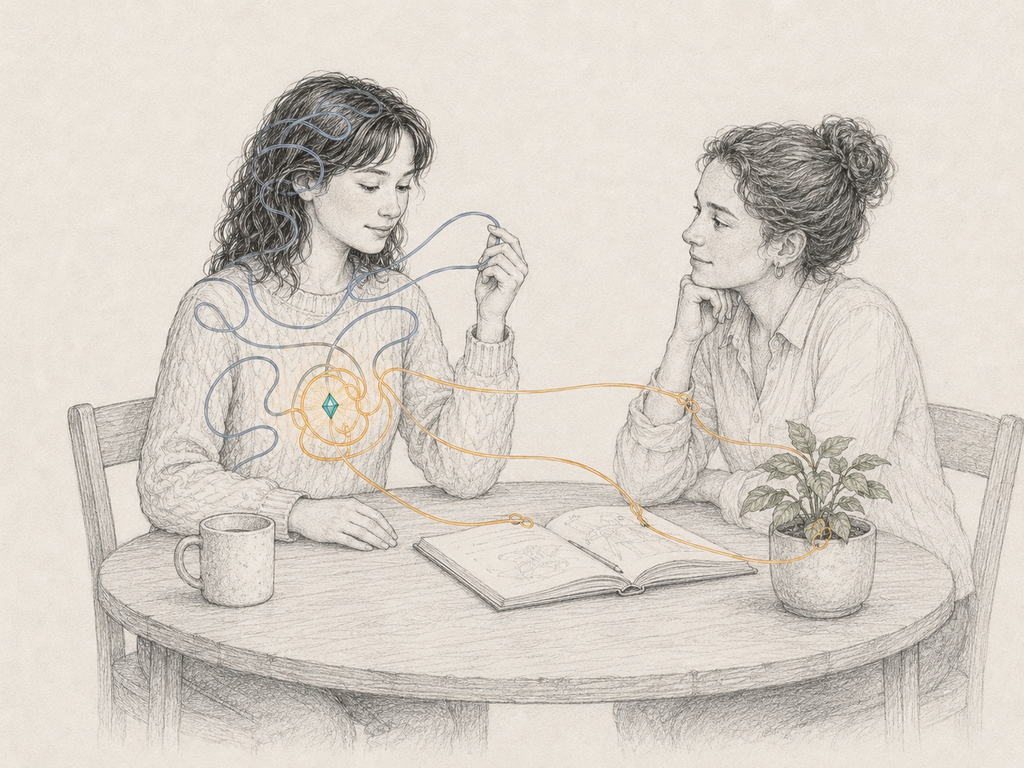
New experiences do not cut the old bands. They build new internal anchors.
At times, one life-giving encounter had to contend with many old experiences. That did not make it powerless. It only meant that it needed repetition. Bands that pull toward life can be internalized too. A kind voice can eventually become our own. Trust, too, can grow from a rare exception into an expected reality.
The Model Behind the Story
In this model, beliefs are not isolated sentences to be replaced with more positive ones. They are condensed relational experiences. Rubber bands make visible what a purely verbal model easily overlooks: direction, tension, repetition, and connection.
| Part of the model | What it means |
| The anchor | A person, group, expectation, or recurring situation to which a band is attached. |
| The direction | A band can pull more strongly toward life — toward connection, unfolding, and meaningful effect — or toward pure functioning, where belonging depends on conformity. |
| The strength | Frequency, emotional intensity, and dependence determine how strongly an experience shapes our model of the world. A single sentence is rarely just a sentence when an entire relationship hangs on it. |
| The elasticity | Life-giving relationships allow movement, distance, and change. Rigid bands demand that we remain in a particular place so the connection is not put at risk. |
| Internalization | Repeated external directions of pull become internal predictions. The original person may be long gone; our system continues to supply their response. |
| Change | New thoughts can provide orientation. New, repeated relational experiences supply the data from which genuinely new internal bands emerge. |
When Things Finally Began to Change
A few months after moving, Alena was sitting at the new table again. The plant by the window had grown a fresh leaf. In front of her lay the same kind of list as on that first morning. But this time, she noticed the pull before she followed it.
She did not cross out every task. She did not turn her life upside down again. She called someone with whom she did not have to function and said, “I can feel myself abandoning myself again.” Then she remained seated for a moment without justifying it.
The old bands were still there. But they were no longer invisible. And for the first time, a small free space opened between the pull and her movement.
Freedom, Alena understood, is not the absence of all rubber bands. Freedom begins when we recognize which bands move us — and can once again build relationships, experiences, and systems that pull toward life.
The external anchor can disappear.
The internal band remains — until another reality has been lived often enough.
And Now?
Some of this may be your story; some of it may make you think of other people. Perhaps you recognized some of your rubber bands. Or perhaps there was only a vague feeling: Something is pulling. I do not know exactly what it is yet, but I know this feeling.
The rubber bands are not flaws in you. They are memories. Experiences became expectations, and expectations became predictions that your body sometimes reacts to before you have time to think. That was not stupid. It was learned.
But memories are old data points. They know a great deal about where you once were. They do not automatically know where you are today or where you are going. When everything changes, the past is no compass for the future.
Questions
So here are a few questions to make the future a little easier to shape:
- Who in your life stands—or once stood—for aliveness?
- Who is—or was—in your life to prove that your view of the Zombie World is right?
- For whom do you embody aliveness?
- For whom do you reinforce the view that the Zombie World is all there is?
- Whom do you keep at a distance because they would disrupt your view of the Zombie World?
- Where does evidence that life and love exist—even for you—threaten the Zombie World?
- Who runs from you because you bring life and love?
All of these questions are about understanding our rubber bands: the ones we have in our own lives, but also the ones we bring into the lives of others. Every interaction we have with another person confirms—and strengthens—certain rubber bands.
No one is to blame for the rubber band itself. But when we strengthen or weaken it, we carry full responsibility. And incongruence between what we do and who we are is a particularly clear sign that we have not yet found our own direction.
When the Reaction Is Bigger Than the Moment
You can often recognize a rubber band when your reaction is bigger or stronger than the situation in front of you. An unanswered message becomes proof that you do not matter. A small uncertainty makes you try to control everything. A desire appears, and before you can even feel it, you explain to yourself why it is impossible.
Sometimes the opposite looks exactly the same: you feel almost nothing. You become factual, tired, or indifferent. That can be a rubber band too. Not every band pulls us into visible distress. Some pull us out of life before life can become dangerous.
In moments like these, you could ask: What is one part of me afraid will happen right now? Not: What is wrong with me? And not immediately: Who is to blame? Only: What does my system believe is about to happen?
Perhaps the answer is:
If I say no, I will lose belonging.
If I show myself, I will be shamed.
If I hope, I will be disappointed.
If I need help, I am weak.
If I rest, I am worthless.
If I think differently, I will be alone.
You do not have to disprove that sentence. For now, it is enough to hear it. In that moment, it is no longer the whole of reality. It is a prediction inside you—a prediction based on data from the situation you have already left. These predictions are precisely how your past travels into your future.
A Short Pause
Perhaps your mind is now looking for explanations and people to hold responsible. Perhaps another part of you is saying: That is not how it is for me at all. That is okay too. This text does not know what is happening inside you better than you do. It is simply offering you a question. You may accept it, change it, or leave it where it is.
Two Maps
Rubber bands do not grow weaker when we tell them they are wrong. After all, they have evidence. So a second question can help:
When did this prediction once make sense?
Perhaps openness really was dangerous in your family. Perhaps you learned that closeness could be withdrawn. Perhaps you were punished for something that was officially encouraged: honesty, responsibility, or dissent.
The old map is allowed to be true. It describes terrain that once existed. And beside it, you may place a second map:
What is different today?
Perhaps you are no longer completely dependent. Today, you may be able to leave, ask, choose, wait, or seek help. Perhaps there are now people who do not disappear when you become visible.
Freedom does not begin by burning the old map. Freedom begins when you no longer have to pretend it is the only one.
Navigation
Now that we have maps, we can navigate more effectively. We can put on a different pair of glasses and see things differently. Here are just a few very condensed examples—things many people talk about today that look different through our new lens.
“Princess Treatment”: Wanting princess treatment has become completely normalized. I want to be a princess or prince, and I want everything done for me. It is the three-year-old inside us: no responsibility, completely cared for.
Through our new lens, the longing for “Princess Treatment” is the last beautiful moment we can still remember—or feel. We want to return to life before the rubber bands pulled us into the Zombie World.
That is also the definition of trauma: the wish that the things tearing us apart had never happened. We wait for the moment when we will wake up and discover that it was all a bad dream. We are a child again. Loved, cared for, and safe.
Depression: Depression is complex and has many contributing factors. But one factor can be that we have grown tired of being torn apart inside. For so long, so many rubber bands have been pulling at us, and for every band we have had to change masks, suppress ourselves, and slip into yet another role.
Then comes the moment when it is simply too much. The “depression” is the end of the suppression. The truth enters our life. Depression makes the tension visible. Releasing that tension would allow healing.
Burnout: Burnout grows out of an “I am not enough” worldview. I therefore have to demonstrate ever more performance and success to prove my worth. Deep inside is the hope that one day it will be enough and I will finally be seen. At the same time, I know that I am trapped like Sisyphus in a pointless hamster wheel. So I push myself to the limit—and beyond it—again.
As with depression, this is the collapse of the protective mechanisms. But these things can themselves become protective strategies: I celebrate collapsing under the inner strain. It becomes the ultimate proof of self-sacrifice, offered in exchange for a little recognition of my worth.
Avoidance: Avoidance means that I avoid genuine closeness. This can look like avoiding everyone. But it can also mean that I am relaxed with almost everybody except the people who might actually become important to me—the ones who want and are able to truly see, hear, understand, and touch me.
Avoidance is a trained basic pattern: an internalized rubber band. I want to get ahead of the disappointment. I do not allow closeness because it will only be taken away again. After all, I “know” that closeness is not available to me. Unfortunately, this is also a reliable way to create permanent disappointment.
Why the Zombie World Usually Wins
When people choose against aliveness, it is often not a real choice. At first, it is a balance of forces.
Every rubber band pulls in a direction with a certain amount of force. Perhaps there are a few very deep bands of hope inside you: the memory of a moment when you felt alive, a person with whom you were allowed to be whole, or the sense that life might hold something else. Yet almost everything you have experienced so far seems to point in the opposite direction. Parents, school, church, friends, and relatives may all have reinforced the same worldview: It would be beautiful—but that is not how life works. When many bands pull toward the Zombie World and only a few pull toward life, the result is not a weakness of character. It is mathematics.
But the equation changes when we see the context. If everyone around me develops cancer, I may learn: Cancer is normal. But I may also discover that we live beside a damaged nuclear power plant. Suddenly, the same experience is no longer evidence of the nature of life. It is the understandable consequence of particular conditions.
We can look at our old data in the same way. Perhaps hope is not naive. Perhaps we simply learned in an environment where aliveness received very little nourishment.
Even so, the way out is not simply to pull harder from the side of life. More pull or pressure initially increases the tension. The system pulls back, our Gecko becomes restless, and the old bands pull even harder. Even a well-intentioned You finally have to start living can become the next act of violence against us.
The path into life therefore depends less on additional pull and more on releasing tension. First, we look at what binds us to the Zombie World, what that band is protecting us from, and whether its prediction is still entirely true today. As these bonds loosen, hope no longer has to overpower the whole old world. The movement toward life that was already there is given room again.
So we need release and a clear direction—but change that grows out of release, not coercion. Supposedly, absolute release exists on both sides: life and the Zombie World. But in the Zombie World, our unmet basic needs keep gnawing at us. And that gnawing is itself one of the Zombie bands that has felt familiar since we were three or four years old.
This is why discernment is the central step: seeing, hearing, understanding, and feeling what is pulling in which direction. Only when I recognize a pull can I follow it—or gently say no.
The Energy Compass
Not every good decision feels good immediately. Learning something new takes energy. Setting a boundary can be sad. Aliveness is not the same as comfort.
Still, after a situation, you can observe:
Am I more or less connected to myself afterward?
Have I become more expansive or more constricted?
Am I more or less connected?
Do I have more choices afterward, or fewer?
There is effort after which you feel larger, and effort after which you have abandoned yourself. There is rest that nourishes you, and the apparent rest of resignation. There is closeness in which you perceive more of yourself, and closeness for which you have to give parts of yourself away.
The energy compass does not pass judgment on individual people. It simply helps you notice the direction in which an experience is moving you.
A New Data Point
You do not have to change your entire life. Your system probably would not believe such an announcement anyway.
One new data point is enough.
Today, you could ask an honest question instead of guessing the answer. You could say a small no and observe what actually happens. You could feel a desire for a moment longer before reasoning it away. You could accept help, not answer a message immediately, or stay with someone who does not try to correct you.
The new data point does not have to prove that the world is safe. It only has to show that more than one experience is possible.
I did something different, and the old prediction did not come entirely true.
That is how a living system learns: not through a better command, but through a new experience.
Through the Eyes of a Child
There is one question that can sometimes make visible what we struggle to recognize in ourselves:
If a child were watching me today, what would they learn from me about themselves, about relationships, and about life?
Would they learn that you have to override yourself to be loved? That adults must always be right? That exhaustion is proof of worth? That desires are dangerous? Or would they experience that people can notice mistakes, apologize, respect boundaries, and still remain connected?
Children do not need perfectly healed adults. They need adults who do not pass their own unfinished healing on as law.
Imagine that you never learned aliveness and then have children. Children are full of aliveness. Their demand for aliveness may feel as though someone were asking you to speak Mandarin—a language you never learned. And you cannot learn it from one day to the next. Your child may learn faster than you. You do not have to be their best teacher. But you can learn alongside them and avoid standing in their way—usually by allowing them to have other people from whom they can learn. The lessons of aliveness are trust, forgiveness, repair, joy, love, safety, self-worth, self-determination, and the ability to shape the world.
Your task is not to turn a child into an improved version of you. Your task is not to prevent them from becoming their own version out of fear.
Another Short Pause
If shame or fear of failure is appearing right now, it may be saying: I should have known this long ago. You do not have to be angry with it. But you do not have to hand the next generation over to it either. I wish some things had been different earlier and I am here today are both allowed to be true at the same time.
The Bands May Come With You
You may keep all your rubber bands. Some will loosen through new experiences. Some may even preserve something valuable: attentiveness, caution, or the memory of what you never want to lose again.
The point is not to never be pulled again. The point is to notice the pull and still be able to choose.
The best time to receive new rubber bands would have been a healthy childhood. You could not choose that. The second-best time is today.
For more background see also 3x Diamond, “Hamster Wheel”, Chocolate Cookie.
Leave a Reply